ROMS-Rutgers
Regional Ocean Modeling System
The Regional Ocean Modeling System (ROMS) is a widely used, open-source, free-surface, terrain-following, primitive equations ocean model designed for studying coastal and regional ocean dynamics. It has been developed by an international community of scientists and modelers since the late 1990s. Please visit MyRoms and ROMSwiki for more information on the model.
ROMS Key Features
Terrain-following vertical (sigma) coordinates: ROMS uses a curvilinear vertical coordinate system that adapts to the ocean bottom topography, allowing for accurate representation of coastal and shelf processes.
Free surface and baroclinic dynamics: The model resolves both the surface elevation and stratified (density-driven) flows, capturing tides, currents, and thermohaline circulation.
Modular and flexible framework: ROMS supports a variety of physical processes including advection, mixing, sediment transport, and biogeochemical cycles, and can be coupled with atmospheric and wave models.
Typical Applications
Coastal circulation and upwelling studies
Estuarine and shelf sea dynamics
Harmful algal bloom modeling
Sediment transport and morphodynamics
Coupled physical-biogeochemical simulations
Operational forecasting and climate research
Below we describe the ROMS interface to DART. Please note that this interface supports the Rutgers version of ROMS only. Other versions of the model are also supported. Please refere to ROMS_ucla for the UCLA interface. If you have any questions regarding this interface or other ROMS-DART related questions, please reach out to the DART team at dart@ucar.edu
Interface Overview
The interface between DART and ROMS supports multiple grid configurations, ranging from fully regular grids to curvilinear (fully irregular) grids. The choice of grid type affects both the compilation and the performance of the interpolation routines.
To compile the DART interface, run quickbuild.sh with the appropriate
grid option:
Regular grid:
./quickbuild.sh reg_gridIrregular grid:
./quickbuild.sh irreg_grid
After compilation, the interface module ROMS_rutgers/mod_mod.f90 is generated.
For grids that are logically rectangular with separable longitude and latitude
coordinates (e.g., rectilinear grids with uniform or nonuniform spacing),
the reg_grid option enables faster and more efficient interpolation by
using optimized search routines based on 1D coordinate arrays.
The irreg_grid option is intended for fully curvilinear grids, where
longitude and latitude vary in both horizontal directions. In this case,
the interpolation requires access to the full 2D coordinate arrays, which
increases both memory usage and computational cost.
The ROMS_rutgers/mod_mod.f90 interface provides the
routines required for DART to interact with the model state and
perform data assimilation tasks, including:
Model initialization and state management
Observation-space interpolation of model state variables
Vertical coordinate transformation and interpolation
Mapping between DART’s state vector and ROMS variables
Note
In many practical ROMS configurations, grids may be irregularly spaced but
still rectilinear. These grids can take advantage of the more efficient
interpolation pathway associated with the reg_grid option.
Observation Handling and Interpolation
Unlike the UCLA ROMS-DART interface, this version does not rely on precomputed observation-space values output by ROMS (e.g., from MODname in s4dvar.in). Instead, it computes observation-space equivalents directly via interpolation routines implemented using the quad_utils module. Interpolation to the observed location is done both horizontally and vertically. Observations outside the model domain or falling on masked grid cells are excluded from the assimilation process (see failure codes below). The interpolation further assumes the model depth to be ordered from deepest to shallowest. It also handles extrapolation gracefully for values above or below the model domain.
! Failure codes: model_interpolate
integer, parameter :: QUAD_LOCATE_FAILED   = 13
integer, parameter :: QUAD_EVALUATE_FAILED = 21
integer, parameter :: SSH_QUAD_EVAL_FAILED = 34
integer, parameter :: QUAD_MAYBE_ON_LAND   = 55
integer, parameter :: OBS_TOO_DEEP         = 89
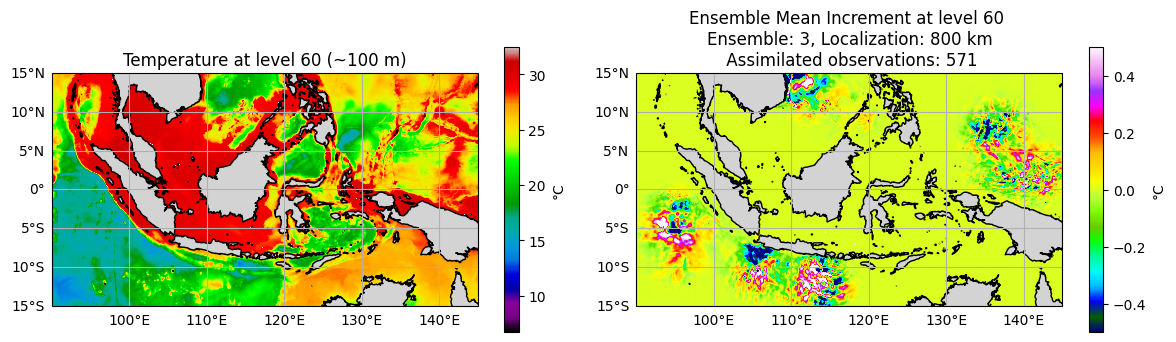
The image below shows an example assimilating Temperature observations from different sources including: XBT, CTD, BOTTLE, MOORING, and FLOAT. The experiment, designed for illustration purposes, uses only 3 members within the Indonesian archipelago. The effective localization radius is set to 800 km. Temperature ensemble mean at a depth of ~100 m is shown in the left panel. Ensemble mean increment (i.e., posterior - prior) at the same depth is shown on the right.
Warning
This interface only supports single time-level variables in ROMS history files. Variables with multiple time levels (e.g., leapfrog schemes in restart files) are not supported and may lead to incorrect assimilation behavior.
Namelist Configuration: model_nml
The ROMS–DART interface is configured through the model_nml namelist. This namelist is read from the file input.nml. Namelists start with an ampersand ‘&’ and terminate with a slash ‘/’. Character strings that contain a ‘/’ must be enclosed in quotes to prevent them from prematurely terminating the namelist.
The table below describes the configurable variables in this namelist:
Variable |
Type |
Default |
Description |
|---|---|---|---|
|
character(len=256) |
‘roms_input.nc’ |
Path to a ROMS NetCDF template file used to extract static grid and mask information. |
|
integer |
1 |
Number of days in each assimilation window. |
|
integer |
0 |
Number of seconds (in addition to days) in each assimilation window. |
|
real(r8) |
0.02 |
Amplitude used to perturb ensemble members for ensemble generation. |
|
logical |
.false. |
Indicates whether to use mean SSH from the template (ensemble mean). |
|
integer |
0 |
Debugging verbosity level. Set >0 for more detailed log output. |
|
character(len=vtablenamelength), dimension(MAX_STATE_VARIABLES * table_columns) |
‘ ‘ |
Specifies the list of ROMS variables to be assimilated. The variable table is parsed as flat strings with metadata. |
Variables Table Format
The variables field in the &model_nml namelist is used to declare each state variable to be included in the DART state vector. Each variable entry consists of five elements (columns), listed in a single Fortran character array:
Field |
Description |
Example |
Notes |
Requirement |
|---|---|---|---|---|
|
Name of the ROMS variable in the NetCDF file. |
‘temp’ |
Must match the ROMS file variable name exactly. |
Required |
|
DART internal quantity label. |
‘QTY_TEMPERATURE’ |
Must be a valid DART quantity name. |
Required |
|
Lower bound as a string, or ‘NA’ for none. |
‘0.0’ |
Used for clamping or bounds checking in DART. |
Optional |
|
Upper bound as a string, or ‘NA’ for none. |
‘NA’ |
Same usage as above. |
Optional |
|
Whether DART should write back this variable to the ROMS restart file. |
‘UPDATE’ |
‘UPDATE’ = write back; ‘NO_COPY_BACK’ = internal use only. |
Required |
Example namelist snippet:
variables = 'temp', 'QTY_TEMPERATURE'        , 'NA' , 'NA', 'UPDATE',
            'salt', 'QTY_SALINITY'           , '0.0', 'NA', 'UPDATE',
            'u'   , 'QTY_U_CURRENT_COMPONENT', 'NA' , 'NA', 'UPDATE',
            'v'   , 'QTY_V_CURRENT_COMPONENT', 'NA' , 'NA', 'UPDATE',
            'zeta', 'QTY_SEA_SURFACE_HEIGHT' , 'NA' , 'NA', 'UPDATE'
Each variable must appear as a consecutive 5-element group in the flat variables array. The interface supports up to MAX_STATE_VARIABLES, each with 5 fields.
Note
Variables marked as ‘NO_COPY_BACK’ are updated within the DART filter but are not written back to the ROMS restart file. 1990s
Only variables in restart files can be updated in ROMS. Ensure roms_filename points to a restart file (e.g., roms_input.nc) when using ‘UPDATE’.
Observation times are assimilated if they fall within ±0.5 × assimilation_period_days from the model forecast time.
It’s recommended to set
use_mean_SSH_from_templateto .true. and provide the ensemble mean as the template fileroms_filename. This ensures the right SSH values are used in the localization routine.
Generating an Initial Ensemble
The ROMS interface provides the ability to create an ensemble of initial ROMS
history files from an initial file by using the perturb_single_instance routine.
You can specify an ensemble of any size in the perturb_single_instance
namelist in input.nml and this program will randomly perturb the
temperature and salinity fields of an initial ROMS history file to generate
the ensemble. The size of the perturbation is set using the namelist parameter
perturbation_amplitude and the resulting initial distribution is Gaussian.
References
Shchepetkin, A.F. and McWilliams, J.C., 2005. The regional oceanic modeling system (ROMS): a split-explicit, free-surface, topography-following-coordinate oceanic model. Ocean Modelling, 9(4), pp.347-404.