HF Radar
This utility converts High-Frequency (HF) radar ocean surface current products into a DART observation sequence (obs_seq) file.
Overview
HF radar systems measure near–surface ocean currents by transmitting and receiving radio waves that scatter off surface gravity waves. These systems are widely deployed by national and regional ocean observing networks, including:
The U.S. Integrated Ocean Observing System (IOOS) HF radar network,
The CODAR SeaSonde instrument family (Commercial provider of HF radar systems commonly used in U.S. and international networks),
Indonesian Coastal Observations (BMKG/Baron Weather) local installations at BATU, DALI, and BADA sites used for the InaCAWO–ROMS project with NSF NCAR.
The converter supports two data families:
Totals (vector currents): gridded eastward (
u) and northward (v) surface currents with optional per-cell standard deviations (stdu,stdv).Radials (single-site line-of-sight currents): curvilinear grids with bearing angle (
bear), range (rnge), QC flag (vflg), and radial velocity (velo).
Each observation is written with a DART kind and associated error variance.
All locations are set to VERTISSURFACE.
Forward operators
HFRADAR_U_CURRENT_COMPONENTuses observeduHFRADAR_V_CURRENT_COMPONENTuses observedvHFRADAR_RADIAL_VELOCITYwith operator: \(U \cos(\phi) + V \sin(\phi)\), where \(\phi\) is the beam bearing in radians.
Input data expectations
Totals files (regular lat/lon):
Dimensions:
lat(nlat),lon(nlon)Variables:
u(lon,lat),v(lon,lat)with attribute_FillValueand units m/s or cm/soptional
stdu(lon,lat),stdv(lon,lat)having the same units as velocitiestimedimension (length 1)
Radials files (curvilinear x/y):
Dimensions:
x(nx),y(ny)(2-D variables)Variables:
lat(y,x),lon(y,x)degrees; longitudes auto-shifted to [0,360)bear(y,x)degrees clockwise from true north (FO converts it to radians)velo(y,x)units m/s or cm/s, auto-converted to m/srnge(y,x)kilometers from instrumentvflg(y,x)QC flag; treated as a non-negative scalar; typical good range [0,1023]
Global attributes:
Site(instrument/site name). If the attribute is not available, the converter sets the instrument to “UNKNOWN”.
Note
Time handling (both types): The converter reads the time variable and units attribute, parses the calendar reference, and constructs the DART time. Example accepted formats:
seconds since YYYY-MM-DD hh:mm:ss
hours since   YYYY-MM-DD hh:mm:ss
Build & run
Build like other DART converters. Then run with an input.nml that includes
obs_def_ocean_nml for the forward operator and hf_to_obs_nml.
The program writes a single output sequence defined by file_out.
./hf_to_obs
Observation Errors
Observation error standard deviations for totals U and V are read from input HF radar NetCDF file, if available. If the uncertainties are not part of the raw data, they are set 0.001 m/s.
Radial (single-site) files almost never include explicit per-cell uncertainties, because each radial velocity comes from a spectral peak fit in the Doppler spectrum, and the uncertainty often depends on SNR, spectral width, antenna pattern, and geometric precision.
The radial observation errors are set based on the IOOS, SEACOOS guidelines, where a typical \(\sigma_0\) range for a coastal CODAR radial is 0.15 m/s.
We also apply an error growth with range to mimic degradation: \(\sigma(r) = \sigma_0 \left(1 + \alpha \frac{r}{r_{max}}\right)\); \(\alpha \approx 1.0\)
Finally, all error SD values are clamped to the range [0.001, 0.4] m/s.
Namelist
This namelist is added to the rest of DART program namelists in file input.nml. Namelists start
with an ampersand ‘&’ and terminate with a slash ‘/’.
&hf_to_obs_nml
   file_in          = 'CODAR_BADA_2025_10_06_0310-1759720200.nc',  ! single file (or '')
   file_list        = 'HF_file_list',                              ! text file of paths (or '')
   file_out         = 'obs_seq.hf',
   radial_rmin_km   = -1.0,     ! <0: derive from data (skip ~first 1 km)
   radial_rmax_km   = -1.0,     ! <0: derive from data (max finite range)
   avg_obs_per_file = 500000,   ! pre-allocation hint
   debug            = .true.
/
You must set exactly one of
file_inorfile_list.If both
radial_rmin_kmandradial_rmax_kmare negative, the converter automatically derives them from the data extents.Velocities in cm/s are automatically converted to m/s.
QC filter: 0 ≤ flag < 1024; out-of-range or NaN values are excluded.
Namelist item |
Type |
Default / Allowed values |
Description |
|---|---|---|---|
|
character(len=256) |
‘ ‘ (empty string) |
Path to a single HF radar NetCDF input file.
Mutually exclusive with |
|
character(len=256) |
‘ ‘ (empty string) |
Path to a text file containing a list of NetCDF files,
one filename per line.
Only one of |
|
character(len=256) |
|
Name of the DART observation sequence output file. If the file already exists, it will be replaced. |
|
real(r8) |
|
Minimum accepted range (km) for radial observations. If negative, the converter uses the data minimum + 1 km as the lower bound. |
|
real(r8) |
|
Maximum accepted range (km) for radial observations. If negative, the converter uses the data maximum range found in the file. |
|
integer |
|
Estimated average number of observations per input file. Used to pre-allocate sequence memory efficiently. |
|
logical |
|
If true, prints detailed progress information and a summary of counts, statistics, and instrument sites. |
Key Routines
Below are brief descriptions of the main routines used in hf_to_obs:
configure_HF_file: Opens the NetCDF file, determines whether it contains totals or radials, reads the time variable and its units (seconds/hours since base date), and constructs a DART
time_typeobject. Setshf_kind = 0for totals andhf_kind = 1for radials.read_hf_totals: Reads gridded totals:
u(lon,lat),v(lon,lat), and optionalstdu,stdvfields. Ensures units are in m/s and applies lower/upper bounds to the observation error standard deviations. Missing values are detected via NetCDF_FillValue.read_hf_radials: Reads single-site radial velocities and supporting metadata including bearing (
bear), range (rnge), and QC flags (vflg). Performs range-dependent error assignment and filters bad or out-of-range data. The radar site name is obtained from the globalSiteattribute.fill_obs: Populates and inserts a new observation into the DART
obs_sequence. Handles both scalar (U, V) and angular (radial) observations. For radials, it assigns a unique instrument ID and callsset_hf_radial_vel()to store the instrument geometry for use by the forward operator.
Output
An observation sequence file is obtained after running the converter.
Here is a sample output from an obs_seq.hf file. Note that for
HFRADAR_RADIAL_VELOCITY extra metadata are gathered, including the
instrument ID and the bearing angle. These are used in the FO
comutations as described above.
obs_sequence
obs_type_definitions
         3
        61 HFRADAR_U_CURRENT_COMPONENT
        62 HFRADAR_V_CURRENT_COMPONENT
        63 HFRADAR_RADIAL_VELOCITY
num_copies:      1  num_qc:       1
num_obs:         3  max_num_obs:  3
HF radar observation
HF radar QC
first:           1  last:         3
OBS      1
3.405999898910522E-002
0.000000000000000E+000
        -1           2          -1
obdef
loc3d
   1.849769674874062       -0.1033755157457358         0.000000000000000     -1
kind
        63
HFRADAR
InsID
      1361
angle
 240.000000000000
         1
 600     155141
2.600160803059251E-002
OBS    2
0.126917576546429
0.000000000000000E+000
       1        3          -1
obdef
loc3d
   1.849701730907843       -0.1025887102601352         0.000000000000000     -1
kind
        61
14400     155141
2.482996394614055E-003
OBS    3
0.210487239870864
0.000000000000000E+000
      -1          2          -1
obdef
loc3d
   1.849701730907843       -0.1025887102601352         0.000000000000000     -1
kind
        62
14400     155141
1.225000039840094E-003
Debug summary
With debug = .true., the converter prints a run summary like:
--- HF converter summary (all files) ---
    Totals kept     : 2764 (22.52%)
    Radials kept    : 3707 (63.91%)
    Dropped by flag : 0
    Dropped by range: 13
    NaN drops (U)   : 4756
    NaN drops (V)   : 4756
    NaN drops (rad) : 2080
    +++++++++++++++++
       U   value min/max/mean (m/s)   :  -6.8351E-01  2.5335E-01 -1.5772E-01
       V   value min/max/mean (m/s)   :  -7.6822E-01  3.7016E-01 -1.2603E-01
     Radial value min/max/mean (m/s)  :  -5.1548E-01  4.5989E-01 -5.2203E-02
    +++++++++++++++++
       U   error SD min/max/mean (m/s):   1.0000E-03  9.9933E-02  7.4407E-03
       V   error SD min/max/mean (m/s):   1.0000E-03  3.2380E-01  1.4143E-02
     Radial error SD min/max/mean     :   1.6125E-01  3.0000E-01  2.1777E-01
    +++++++++++++++++
    Radial instruments processed (3): BATU, DALI, BADA
The converter also prints a log of all processed data files and associated functionality. The example below shows how the converter reads in a radial evlocity file (Input file #2) and a totals velocity file (Input file #6). Important information such as unit conversion, applied instrument range, and observation error computations are reported.
Input file: #2 ../data/BATU_2025_10_06_00_20_00_radial.nc
   * Reading in Radial Velocity: 2025 Oct 06 00:20:00
     Bear angle is in degrees. The FO will convert it to radians.
     Obs "Radial Sea Water Velocity" unit is in cm s-1; converting to m/s.
     Using radial range window: [  3.00 km,  40.02 km]
   * Computed obs errors using a range-dependent strategy.

...

Input file: #6 ../data/CODAR_BADA_2025_10_06_0310-1759720200.nc
   * Reading in TOTAL U and V data: 2025 Oct 06 03:10:00
   * Read in U, V, stdU, and stdV from the input obs file.
     Obs "Eastward Sea Water Velocity" unit is in m/s; no conversion needed.
     Obs "Northward Sea Water Velocity" unit is in m/s; no conversion needed.
   * Clamped obs errors to configured min/max.
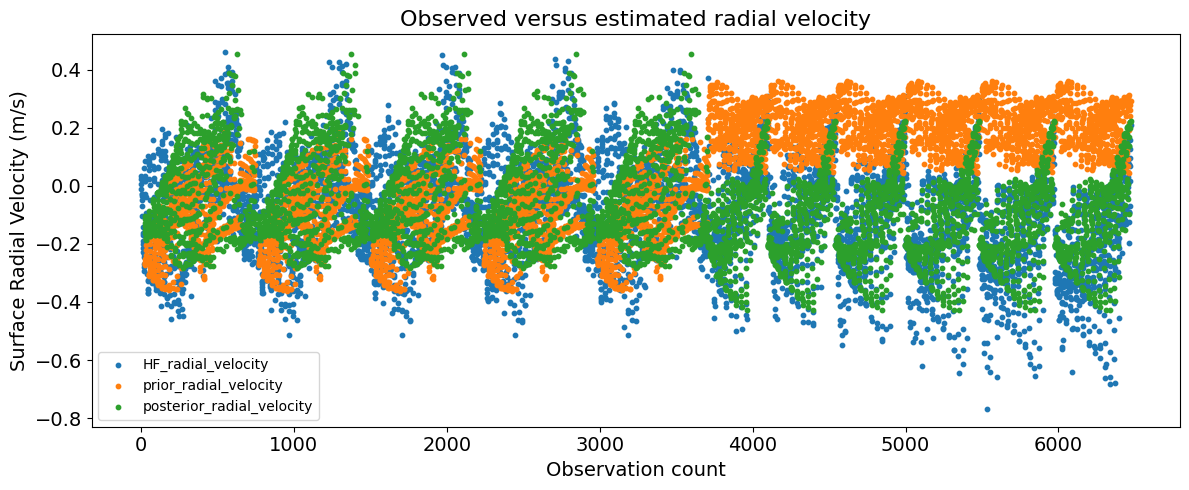
The image below shows a scatter plot (obtained using pyDARTdiags) of the observed and estimated (prior, posterior) radial velocities in a regional ocean example. Note that radial velocities (and total ones too) can be either positive or negative.
Troubleshooting
time dimension > 1 not supported (Totals): The converter currently expects a singleton
timefor totals. Split multi-time files before converting (e.g., with NCO).Unknown units for observed currents: Ensure
u/v/velounits are either m/s or cm/s.Few radials kept: Check
vflgrange conventions and adjust the keep rule in the code if your site encodes “bad/missing” differently. Also verifyrngeunits (km).Inconsistent 2-D dimensions: Confirm that
lat, lon, velo, bear, rnge, vflgall share shape(y,x).
Performance & other tips
Set
avg_obs_per_filein the namelist close to your typical per-file observation count for efficiency.Set
debug = .false.in the namelist for production runs. Printing timestamps, unit conversions, and summaries for every file may dominate wall-time.
Tip
Promote radial error parameters (baseline growth; \(\alpha\)) to the namelist if you want to tune them for obs error computations per network/season.